Episode 3: Role of Libraries in Research Support for Scientific Software
This blog post summarises the third episode of the Research Software and NRENs in Asia series, featuring a conversation about the role of libraries in research support for scientific software across the research lifecycle, with Victoria F Caplan, Head of Research and Learning Support, Hong Kong University of Science and Technology (HKUST).
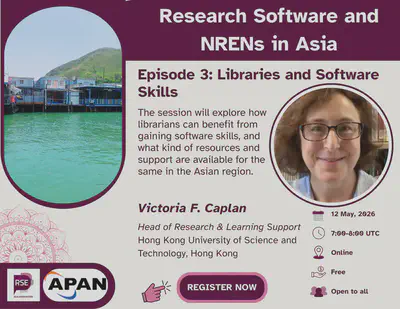
On 12 May 2026, the RSE Asia Association hosted the third episode of its ongoing Community Call series, Research Software and NRENs in Asia, featuring an insightful conversation with Victoria F. Caplan, the Head of Research and Learning Support at the Hong Kong University of Science and Technology. The session explored how software, technical skills, and digital scholarship are reshaping the role of modern libraries and the professionals who work within them.
The series itself is part of the Memorandum of Understanding between the RSE Asia Association and the Asia Pacific Advanced Network, focusing on conversations around research software, infrastructure, open science, and collaboration across Asia. Previous episodes covered topics such as the role of the NRENs in the research software ecosystem, research software and environmental research, open science, open data, and open source software practices. This episode shifted attention toward libraries as evolving digital and research support spaces.
The discussion highlighted an important reality: libraries are no longer only repositories of books and journals. Increasingly, they are becoming hubs for digital scholarship, metadata management, open science, research analytics, technical training, and even software-enabled experimentation.
A career that mirrors the evolution of libraries
Victoria Caplan opened the session by reflecting on her 33-year journey at HKUST Library. Beginning in cataloguing and metadata work, she later moved into user services, access services, and eventually research and learning support. Along the way, she witnessed the evolution of library formats from microfiche, CDs, DVDs, and laserdiscs to digital repositories, online scholarly communication, and research data management.
Her career trajectory itself reflected the transformation of libraries over the past few decades. Libraries today are expected not only to help users discover information but also to support researchers in managing their outputs, preserving digital content, navigating open access requirements, and understanding the broader research ecosystem.
Victoria also spoke about how completing her own MPhil later in her career helped her better empathise with postgraduate researchers. Having personally experienced the research process gave her deeper insight into the kinds of support students and scholars truly need.
The moment software became central to libraries
One of the most memorable reflections from the session came when Victoria described the moment she realised software and networks would fundamentally transform research support. She traced this back nearly 40 years to 1986, when an archivist at her university used an early networked system to locate archival materials for her undergraduate thesis in another city. Before that experience, access to information had been limited to local card catalogues and physical indices.
That moment revealed the power of networked information systems: the idea that knowledge could be discovered and connected beyond the physical boundaries of one library. Long before the modern web existed, the foundations of digital scholarship and networked research infrastructure were already emerging. One of Victoria’s reflections captured the transformational nature of networked research infrastructure:
– Victoria F. Caplan
Although she was describing an experience from the 1980s, the observation still resonates today. Research support increasingly depends on connected systems, interoperable platforms, and digital access that extends far beyond the walls of a single institution.
The expanding technical skillset of library professionals
As the discussion progressed, Victoria outlined the growing range of software and technical skills now expected within libraries. Her answer painted a picture of librarianship that is increasingly intertwined with data, software systems, analytics, and digital infrastructure.
Among the key areas she highlighted were metadata and data management, data cleaning and quality assurance, bibliometrics and research analytics, reference management tools such as BibTeX, Zotero, and EndNote, Integrated Library Systems (ILS), cybersecurity and privacy awareness, intellectual property and digital rights management, research databases and discovery systems, AI-assisted literature review tools, and interactive teaching and workshop design.
A recurring theme throughout the conversation was that technical skills are meaningful only when tied to a practical purpose. Libraries are not adopting software for its own sake. Rather, these tools are increasingly essential for helping researchers discover, organise, preserve, analyse, and disseminate knowledge effectively.
Victoria also emphasised the ethical responsibilities that come with digital infrastructure. Libraries often sit between users and large commercial platforms that collect significant amounts of data. As a result, librarians must think carefully about privacy, intellectual property, and responsible stewardship of information.
Learning through curiosity, community, and experimentation
One of the strongest messages from the session was the importance of creating environments where staff can explore, experiment, and learn continuously. Rather than enforcing rigid top-down skill development programmes, Victoria advocated for fostering curiosity. People should be encouraged to explore areas they genuinely care about and then discover how those interests can connect back to organisational needs.
At the HKUST Library, this culture of learning takes many forms:
- Staff are encouraged to attend webinars, conferences, and university training programmes.
- Participating in professional development activities is not just a good-to-do thing; instead, it is an expectation.
- Colleagues share learning notes after professional development activities.
- Internal “LibConnect” sessions allow staff to present ideas and experiences to others in an informal setting with snacks and tea.
- An AI interest group, created in 2023, helps staff collectively explore emerging technologies.
- Staff are supported in applying new skills through practical projects.
Victoria shared a particularly creative example involving an internal Mid-Autumn Festival AI image-generation challenge. In fall 2023, Staff experimented with free AI image tools to create festival-themed visuals, which were later used on library communications platforms. The activity was intentionally playful and low-pressure, helping reduce intimidation around new technologies while encouraging hands-on exploration. She repeatedly returned to the importance of creating environments where curiosity is encouraged rather than restricted:
– Victoria F. Caplan
This idea became one of the central themes of the discussion. Technical growth, according to Victoria, does not happen through rigid mandates alone. It emerges when people are given space to experiment, ask questions, and connect their interests to meaningful work.
From learning to application
Throughout the webinar, Victoria stressed that certifications alone are not enough. Technical knowledge must be translated into practice. One of the mistakes she warned against was accumulating badges and credentials without finding ways to integrate those skills into everyday work. To encourage practical application, the HKUST Library supports small internal projects where staff can experiment with coding, analytics, and digital tools.
Some of the examples are:
- An open-access journal finder that helps researchers identify journals covered by institutional publishing agreements.
- Interactive Library data analytics dashboards.
- Digital humanities online tutorials.
- A temperature heat map project created with sensors and student collaboration in 2024 to help users find warmer or cooler study spaces in the library.
Another memorable insight from the session focused on the relationship between theory and practice:
– Victoria F. Caplan
Victoria emphasised that technical learning becomes valuable only when people are able to apply it in practical contexts. Certifications and training courses are useful, but their real impact comes when they help solve problems, improve workflows, or support users more effectively.
Managing constraints in real institutions
The conversation also addressed a more difficult challenge: balancing innovation with limited time, staffing, and resources.
Victoria spoke candidly about the realities of management. Supporting professional development often means making difficult choices about priorities. If staff spend time learning new tools or technologies, then some older workflows or lower-priority activities may need to be reduced or retired. She described how libraries must continually evaluate what still provides value and what persists simply because “it has always been done that way.”
One example involved metadata practices. Decades ago, librarians spent extensive time manually refining and perfecting metadata records. Today, much metadata arrives directly from publishers, often imperfectly. While clean metadata still matters, libraries must balance perfectionism against newer priorities and user expectations. Victoria humorously described the shift as moving from “Savile Row bespoke suit metadata” to “fast fashion”, an insight from her University Librarian, Dr Gabi Wong.
While discussing organisational change, Victoria used an old piece of writing advice, applied to organisational change. that resonated strongly with the audience:
In the context of libraries, this referred to the difficult but necessary process of letting go of workflows or practices that may once have been valuable but no longer serve users effectively. Making space for innovation often requires making difficult choices about priorities.
Future-proofing is impossible - but adaptability matters
Toward the end of the session, Victoria was asked what advice would she give to future librarians and early-career professionals hoping to “future-proof” their careers. Victoria’s response was refreshingly honest:
– Victoria F. Caplan
Rather than chasing certainty, she encouraged participants to cultivate adaptability, curiosity, and resilience. Technologies will continue changing, but the ability to learn and evolve remains far more durable than mastery of any single tool.
She encouraged participants to explore widely, develop both technical and social skills, build expertise in areas they genuinely care about, stay open to changing technologies and workflows, and focus on the enduring questions behind the tools.
One particularly memorable observation was that while technologies change, many of the underlying questions remain the same. Libraries will always need to think about:
- how knowledge is organised,
- how access is preserved,
- how privacy is protected,
- how information is transmitted ethically,
- and how people connect with trustworthy information.
Victoria also shared a quote from a science fiction novel that she felt captured the relationship between technology and professional practice:
– Victoria F. Caplan, quoting from a science fiction novel
She used this idea to explain how libraries continue to face enduring challenges around access, preservation, discovery, and ethics - even as the technologies used to address those challenges evolve dramatically over time. Victoria also referenced S. R. Ranganathan and his famous Fifth Law of Library Science:
– Victoria F. Caplan, referencing S. R. Ranganathan
That quote captured the spirit of the entire conversation. Libraries are not static institutions. They continuously evolve alongside technology, research culture, and society itself.
Libraries as connectors in the research ecosystem
During the audience Q&A, participants discussed integrated library systems, institutional repositories, and the organisational structure of research support services at the HKUST. Victoria explained that the HKUST Library maintains a strong systems team and has historically invested heavily in digital infrastructure and remote access services.
An especially interesting discussion emerged around institutional differences. A participant from the University of Melbourne noted that many similar services at their institution exist outside the library.
Victoria reflected that organisational boundaries often emerge from institutional history rather than strict rules about where activities “should” belong. What matters most is not necessarily which department owns a service, but whether the institution successfully supports researchers, preserves knowledge, and enables access.
Final reflections
This episode highlighted that libraries are deeply connected to the future of research software, digital scholarship, and open science. Far from being passive support units, modern libraries are increasingly active collaborators in research ecosystems.
They are places where metadata meets ethics, where technical infrastructure meets teaching, and where curiosity drives continuous learning. Towards the end of the conversation, Victoria summarised one of the most important lessons for professional growth:
– Victoria F. Caplan
The comment reflected the broader spirit of the session itself: learning becomes more meaningful when knowledge, experiences, and experimentation are shared openly across communities.
Perhaps the most important takeaway from the conversation was that technical transformation in libraries is not only about software adoption. It is equally about people: creating cultures that encourage experimentation, sharing, mentorship, and curiosity.
As research ecosystems across Asia continue evolving, these conversations between librarians, research software engineers, digital scholarship practitioners, and research communities will only become more important.
What’s next?
Meanwhile, RSE Asia encourages community members to:
- Participate in the ongoing research software landscape survey in Asia, which is open until 30 June 2026. You also stand a chance to win a cash prize of £10 for 5 participants based on a raffle.
- For the 4th episode of the community conversation series Research Software and NRENs in Asia, on 15 July 2026, register for Episode 4: Open Science, Research Infrastructure, and Collaboration, where we welcome Su Nee Goh, Deputy Director, Nanyang Technological University (NTU), Singapore, with whom we will discuss open science, research infrastructure, and collaboration across the Asian research ecosystem.
- Join the RSE Asia Community Membership to get the latest news.
- Follow RSE Asia on LinkedIn for updates and opportunities.
Resources:
If you were not able to join the meetup live or would like to revisit it, the YouTube video recording of the episode is available.
Throughout the meetup, the guest, the facilitators, and the participants shared a bunch of useful resources for the community for shared progress. We have compiled it in the form of a Community Resource Sheet. Definitely, check it out!

Bhogal, J., Caplan, V. F., & Bhogal, S. K. (2026). Resource Sheet: Episode 3: Role of Libraries in Research Support for Scientific Software. Zenodo. https://doi.org/10.5281/zenodo.20510761.
Learn more about us
If you have any questions about, please reach out to us at: rse.asia.association@gmail.com. For more information and to join upcoming events, visit:
- Website: https://rse-asia.github.io/RSE_Asia/
- For the latest news, events, activities, and opportunities, follow us on our LinkedIn page
- To join the RSE Asia community, please fill out our short Community Membership Form