Connecting NRENs and Research Software in Asia
This blog post summarizes the first episode of the Research Software and NRENs in Asia series, featuring a conversation with APAN’s General Manager, Liana Jacinta Jaganathan.
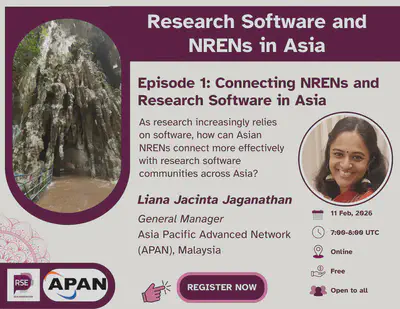
On the International Day of Women and Girls in Science, 11 February 2026, the RSE Asia Association launched a new community conversation series on Research Software and NRENs in Asia. This series is a part of a MoU between RSE Asia and the Asia Pacific Advanced Network (APAN). The series aims to explore how research software, infrastructure, and regional collaboration intersect across the Asia-Pacific region.
In this first episode, co-founders Jyoti Bhogal and Saranjeet Kaur welcomed APAN’s General Manager, Liana Jacinta Jaganathan, to chat about the origins of APAN, its evolving mission, and the growing importance of research software engineers (RSEs) in the regional research ecosystem.
What is APAN? Why and how was it created?
APAN was established in the late 1990s as a strategic response to the growing need for cross-border digital research collaboration. As data-intensive science began to transcend national boundaries, it became clear that individual countries could not fully realise their research potential in isolation.
Today, APAN is a consortium of 24 members, primarily National Research and Education Networks (NRENs) within Asia, alongside associates outside Asia and, recently, industry members too. While NRENs provide high-performance network infrastructure, APAN acts as a collaborative platform for bringing economies together to share resources, expertise, and innovation.
From its early foundations, championed by Japan, Korea, Australia, and Singapore, APAN has grown into a vibrant, multi-layered community. It began as a focus on connectivity and has evolved into a broader mission to enable meaningful and impact-driven collaboration.
APAN has multiple Working Groups under the two heads - Technology and Application. Some of the first working groups were those for agriculture, telemedicine, and network engineering.
Infrastructure needs content: Why Research Software matters
A powerful metaphor from Liana captured the essence of the discussion:
Infrastructure without software is like a highway without vehicles.
High-speed networks alone are not enough. Without research software, data pipelines, simulations, gateways, and analysis tools, the infrastructure remains underutilised.
Research software engineers play a critical bridging role. They transform raw connectivity into actionable knowledge. They build the engines that move data across systems and turn bandwidth into insight. As Liana emphasised, RSEs translate “bit transport” into “knowledge-level insight.”
For the APAN and for the broader research ecosystem, this makes the research software community not optional, but essential.
Open science and cross-border collaborations
One of the highlights of the discussion was APAN’s Open Science Collaborative and Resource Working Group (OSCR), formerly known as the Open and Sharing Data Working Group.
This group brings together experts across the various working groups of APAN (like agriculture, disaster mitigation, telemedicine, and more). Liana shared about collaboration on open data and open science not only within Asia, but also beyond. These collaborators include France, Sri Lanka, Thailand, Indonesia, and UNESCO. These collaborations demonstrate how data-intensive disciplines can converge through shared platforms.
Cross-border collaboration is embedded in APAN’s DNA. Through connections with global partners such as the GÉANT, Internet2, and UbuntuNet Alliance, APAN acts as a critical node in the global research network architecture.
Importantly, inclusivity remains central. Through fellowship programs and capacity-building initiatives, APAN ensures that researchers from developing economies have equitable opportunities to participate and lead.
The future: From connectivity to impact
Over the last two decades, NRENs have shifted from being ‘pipe providers’ to becoming ‘service orchestrators’. Today, conversations are no longer about bandwidth alone, but about how networks can help solve real-world problems like:
Predict disasters
Address water and climate crises
Enable AI and quantum computing
Support telemedicine and public health
Reduce carbon footprints through green computing and sustainable software
When we discussed the emerging opportunities for research software engineers, Liana shared about multiple avenues, including:
Open-source AI development
Quantum-safe infrastructure
Security and privacy engineering
Sustainability-driven (green) software engineering
Data integration across environmental, human, and animal systems
The ecosystem is becoming symbiotic. Software increasingly defines how networks behave in real time. As infrastructure becomes programmable, the boundary between network and software continues to dissolve.
Leadership, community, and human connections
Reflecting on her 20-year journey with APAN, from being a network engineer to the General Manager, Liana described APAN as a second family. What excites her most is not just technological evolution, but the people.
APAN meetings now showcase real-world impact - from telemedicine programs with hundreds of participants to disaster mitigation initiatives like those responding to floods in Sri Lanka. The question has shifted from
How many gigs does your network have?
to
How does your network solve real-world problems?
This evolution mirrors the aspirations of the research software community itself.
Advice for young researchers and RSEs
When asked for one piece of advice for young researchers and developers in Asia-Pacific, Liana offered a powerful closing thought:
Don’t just build for your organisation. Build for the ecosystem.
This message resonated deeply with the spirit of the series. Research software is not just code - it is an infrastructure for collaboration, resilience, and shared progress.
What’s next?
The conversation continues! The second episode will feature Dr. Veerachai Tanpipat, who leads several APAN working groups (agriculture, disaster mitigation, and the Open Science Collaborative and Resource (OSCR)).
Meanwhile, RSE Asia encourages community members to:
- Participate in the ongoing research software landscape survey in Asia, which is open until 31st March 2026. You also stand a chance to win a cash prize of £10 for 5 participants based on a raffle.
- Register for Episode 2: Research Software and Environmental Research in Asia, where we welcome Dr. Veerachai Tanpipat, Senior Expert, Hydro Informatics Institute, Thailand, with whom we discuss open science practices and how they help to solve real-world problems with the APAN infrastructure.
- Join the RSE Asia Community Membership to get the latest news.
- Follow RSE Asia on LinkedIn for updates and opportunities
This kickoff episode made one thing clear: when research software, infrastructure, and community align, the possibilities extend far beyond connectivity.
They shape the future of research across Asia and beyond.
Resources:
If you were not able to join the meetup live or would like to revisit it, here’s the YouTube video recording of the episode. Throughout the meetup, the guest, the facilitators, and the participants shared a bunch of useful resources for the community for shared progress. We have compiled it in the form of a Resource Sheet. Definitely, check it out!
Resource sheet: Bhogal, J., Jaganathan, L. J., & Bhogal, S. K. (2026). Resource Sheet: Episode 1: Connecting NRENs and Research Software in Asia. Zenodo. https://doi.org/10.5281/zenodo.18846080
Learn more about us
If you have any questions about, please reach out to us at: rse.asia.association@gmail.com. For more information and to join upcoming events, visit:
- Website: https://rse-asia.github.io/RSE_Asia/
- For the latest news, events, activities, and opportunities, follow us on our LinkedIn page
- To join the RSE Asia community, please fill out our short Community Membership Form